Sprinklers water grass. Your beds and trees need something else.
Aim a spray head at a flower bed and most of the water never reaches a root.
September 6, 2026 · 3 min read
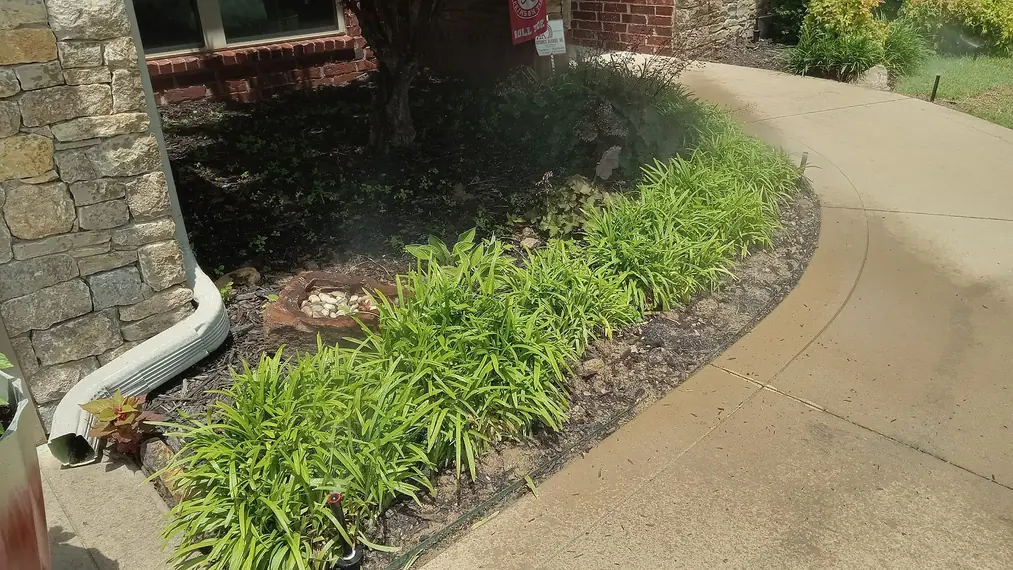
Most irrigation systems in Tulsa were designed around turf, and turf is what they are good at. An open expanse of Bermuda or fescue is exactly the situation a spray head or a rotor was engineered for. The trouble starts when the same tool gets pointed at everything else on the property.
What goes wrong when a spray head waters a bed
A sprinkler works by throwing water through the air across an area. In a planted bed that means most of what it throws lands on foliage rather than soil. Some of it evaporates on the way, especially on an August afternoon here. Some of it runs off the mulch, which sheds water surprisingly well when it is dry. Some of it hits the siding, the windows and the fence.
The plants end up with wet leaves and dry roots, which is close to the worst combination available. Persistently wet foliage in humid Oklahoma summers is how fungal problems start, while the root zone under the mulch never receives a deep soak. People then water the bed longer, which makes the foliage wetter without meaningfully changing what happens underground.
It is also wasteful in a way that shows up on the bill. Water delivered directly to the root zone on a weather-aware controller typically cuts irrigation use by thirty to fifty percent compared with an older system that sprays everything the same way.
Three tools, three jobs
Bed and garden irrigation is not one method. It is a small set of them, chosen to match what is planted:
- Drip line runs under the mulch through flower beds, borders and vegetable gardens. It releases water slowly at the base of each plant, which suits clay soil particularly well because slow application is the only way clay absorbs rather than sheds.
- Micro-spray covers shrubs, ground cover and specialty plantings where a wider pattern is genuinely wanted but a full sprinkler head would be far too aggressive.
- Bubblers sit at the base of trees and larger specimens. They fill a basin and let it soak deep, which is what a mature oak or an establishing crepe myrtle actually wants rather than a light daily sprinkle across the surface.
Trees in particular are badly served by lawn irrigation. A shallow daily watering encourages surface roots and does nothing for the deep root system that keeps a mature tree standing through a dry Oklahoma summer.
Zoning is where the design work actually happens
Choosing emitters is the easy part. The design decision that matters is which plants share a zone, because everything on one zone gets the same water for the same length of time on the same days.
A raised vegetable bed in full sun and a shaded border under a mature oak both want water. They do not want it on the same schedule, and they are not close. Put them together and one of them is permanently wrong. The same is true of established shrubs against newly planted annuals, or a south-facing border against a north-facing one.
Getting this right is also what makes a smart controller worth having. Weather-based scheduling adjusts run times as the season moves, which matters more in Zone 7 than people expect, because a Tulsa spring and a Tulsa July are not the same climate and a fixed schedule can only be correct for one of them.
Adding it to a system you already have
Bed irrigation is usually added to an existing sprinkler system rather than built alongside it. The question worth answering first is whether your current pressure and controller have room for the extra zones, because adding load to a system that is already under-pressured makes the existing problem worse rather than adding a new capability.
That check is part of the design consult, and it is a good example of why the consult happens on the property. What you planted and where you planted it is the entire brief, and no one can assess it from a phone call.
If you are planning new beds or a full landscape rather than retrofitting existing ones, talk to somebody before anything goes in the ground. Running drip through open soil is straightforward work. Threading it under established plantings and finished mulch is not.
Pro Sprinkler designs bed, garden and tree irrigation across Tulsa and Green Country, using Hunter and Rain Bird components so any competent technician can service the result. The on-site consult is free.
Pro Sprinkler, (918) 592-5555
Call (918) 592-5555More articles
Why your Tulsa yard is still wet three days after the rain
Watering less will not dry out a wet corner. The water has to be given somewhere to go.
When to winterize a Tulsa sprinkler system, and what a blow-out actually does
Water expands when it freezes. Everything about winterization follows from that one fact.