Why your Tulsa yard is still wet three days after the rain
Watering less will not dry out a wet corner. The water has to be given somewhere to go.
September 6, 2026 · 4 min read
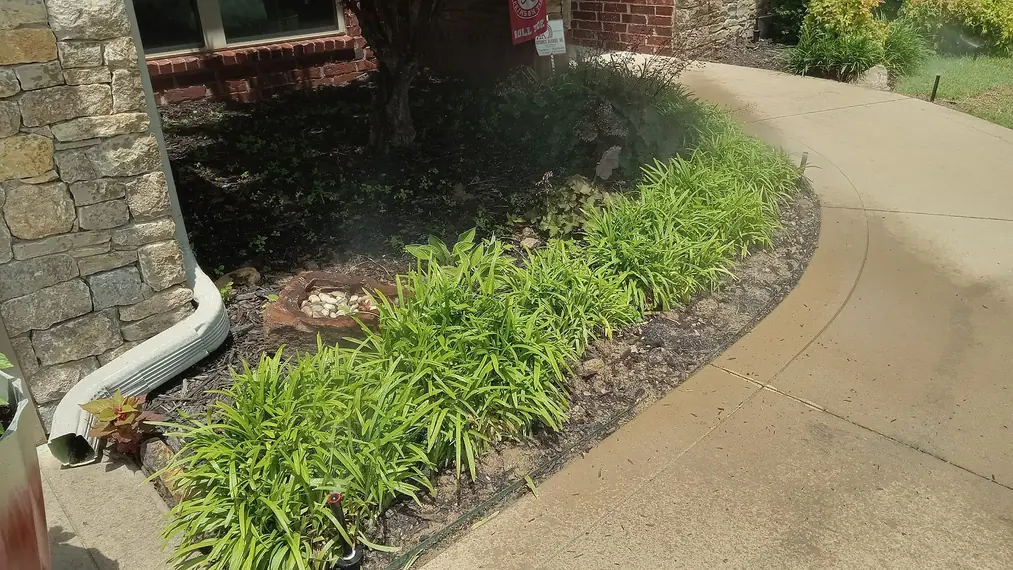
There is a version of this yard on almost every street in Tulsa. The lawn is fine everywhere except one corner, and that corner has been soft since March. The grass there went yellow, then thin, then bare. The mulch in the bed beside it stays black and grows a white fuzz. After a storm the water sits for two or three days while the rest of the yard dries out in an afternoon, and if the spot happens to be against the house, the crawl space smells like it.
Most people treat this as a watering problem and turn the sprinkler zone down. It never works, and it is worth understanding why.
Clay does not drain. It holds water like a bathtub.
The soil under most of Tulsa and the surrounding Green Country towns is heavy clay. Clay particles are extremely fine and they pack tightly, which means water cannot percolate down through them at any useful speed. Sandy soil takes rain straight down into the ground. Clay refuses it, so the water stays at the surface and starts travelling sideways, looking for the lowest point on your lot.
Whatever is sitting at that lowest point is what suffers. Turf roots need air as much as they need water, and saturated ground has no air in it, so the grass in a chronically wet spot effectively drowns. That is why a wet patch and a drought patch can look almost identical from the porch: both are brown, thin and struggling, and both are a root system that cannot get what it needs.
It also explains the thing that confuses people most. Turning the irrigation down does not dry the low corner out, because most of the water arriving there did not come from the sprinkler. It came off the roof, off the driveway, off the neighbor's slope, and it went to that corner because that is where the ground falls. All you achieve by cutting the zone is starving the grass that was already suffering.
Where the water is actually coming from
When we walk a wet yard, we are not really looking at the wet spot. We are looking upstream of it. Four sources account for most of what we find:
- Roof water. A downspout discharging three feet from the foundation puts an enormous volume into one small area every time it rains. On clay it has nowhere to go but sideways, usually along the footing.
- Hardscape. Driveways, patios and paths shed almost one hundred percent of what lands on them. Sheet flow crossing a driveway edge is a common cause of a soggy strip that seems to have no source.
- Grade. Sometimes the ground simply falls the wrong way, often because a previous landscaping project changed it. Water is not negotiable about this.
- Irrigation. Sometimes it genuinely is part of the volume, especially where a zone has drifted out of alignment and is throwing onto an area that was never meant to get it.
This is also why we handle drainage and irrigation as one conversation instead of sending people to two different companies who each blame the other. The crew that maps your zones is the crew that knows where the water ends up.
What actually fixes it
The goal is never to make clay drain. It will not. The goal is to build the shortest clean path between where the water arrives and somewhere it can safely leave, and then to let gravity do the work.
A French drain is a gravel trench with a perforated pipe in it, set below the wet ground so water in the soil has a lower, easier route than staying put. It is the right answer for a chronically saturated area rather than a puddle. Catch basins and area drains are grated boxes set at low points that take surface water off the top and put it into a pipe. Channel drains do the same job in a long line, which is what you want along a driveway or a patio edge where the water arrives as a sheet rather than a pool.
Downspouts get buried and carried well away from the structure instead of dumping at the foundation. Sump discharge gets routed properly off the building rather than into the same corner it just came out of. And where the fall is genuinely wrong, the grading gets corrected, because no pipe will beat a slope that is pointing at your house.
Most yards need two or three of those working together. Very few need all of them, and any assessment that recommends all of them on a normal residential lot is worth a second opinion.
The timing that saves the most money
If you are planning new beds, a patio, a retaining wall or a full landscape this year, deal with the drainage first. Running drain lines through open ground is ordinary work. Retrofitting them after the sod is down, the beds are planted and the hardscape is set costs two to three times as much, for the obvious reason that the fix has to run underneath the thing you just paid for.
Pro Sprinkler assesses drainage free on site anywhere in Tulsa, Broken Arrow, Bixby, Jenks, Owasso and the rest of Green Country, because a yard's grade is not something anyone can diagnose over the phone. If a corner of yours has been soft since spring, it is worth having someone stand in it.
Pro Sprinkler, (918) 592-5555
Call (918) 592-5555More articles
When to winterize a Tulsa sprinkler system, and what a blow-out actually does
Water expands when it freezes. Everything about winterization follows from that one fact.
Spring startup: what to check before you let the system run
The most expensive mistake in April is opening the main valve quickly.